
The Harnekop Bunker is a former nuclear bunker of the National People’s Army (NVA) of the German Democratic Republic (GDR). It’s the second former GDR bunker close to Berlin I visited.
The nuclear bunker was so secret, that it was completely preserved. There’s no vandalism and even electricity still works. In this blog post I’ll share photos from my visit, explain what to expect and how to book a legal urban exploration tour to the Harnekop Bunker.
Table of Contents
Know Before You Go to Bunker Harnekop
The bunker was built in the 1960s and was used by the NVA for nuclear weapons training and research. Allegedly it featured a wired connection to Berlin and in case of a nuclear epxlosion, the bunker would immediately be locked. Construction work was concealed and thus only few people knew about it. After it’s decommission, the bunker was locked and thus preserved as a time capsule. So contrary to the Freudneberg bunker, everything you can see there is still intact.
Due to its remote location you need a car to visit it. It’s about a one hour drive from Berlin.
If you plan to visit the bunker make sure to bring a jacket even during summer. It’s rather chilly in the bunker. I also recommend bringing a flashlight. But more on that further down the blog post.
Today you can visit the bunker by means of a public urbex tour conducted by e.g. go2know. You’ll find the link at the at the bottom of the page right after the photos.
Photo Highlights from Inside the Harnekop Bunker
The bunker is hidden blow two residential buildings and it’s three floors deep. Inside you’ll find everytinghing you’d expect. From sleeping rooms to sick bays to communication rooms and devices and a control rool.
Sleeping Rooms
There are several types of sleeping rooms in the bunker. Depending on the military rank, the staff had to sleep in multi-bed-rooms or could rest in single-bed-rooms. The photo below shows one of the multi-bed-rooms for lower rank personal.
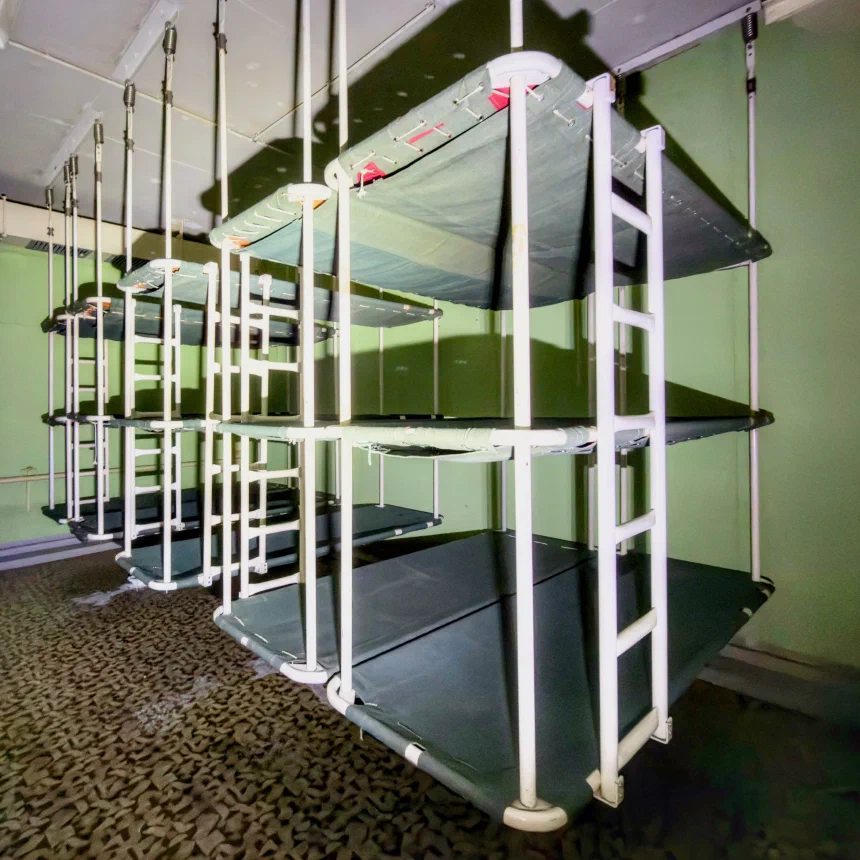
Yes, you’re right. These beds are hanging from the roof. The purpose was to minimize potential bed shake when the bunker was being attacked. The entire bunker itself was built on huge springs for the same purpose.
The Airlock
Like many other bunkers the nuclear bunker Harnekop had an airlock to prevent nucelar or chemical waste entering the bunker.
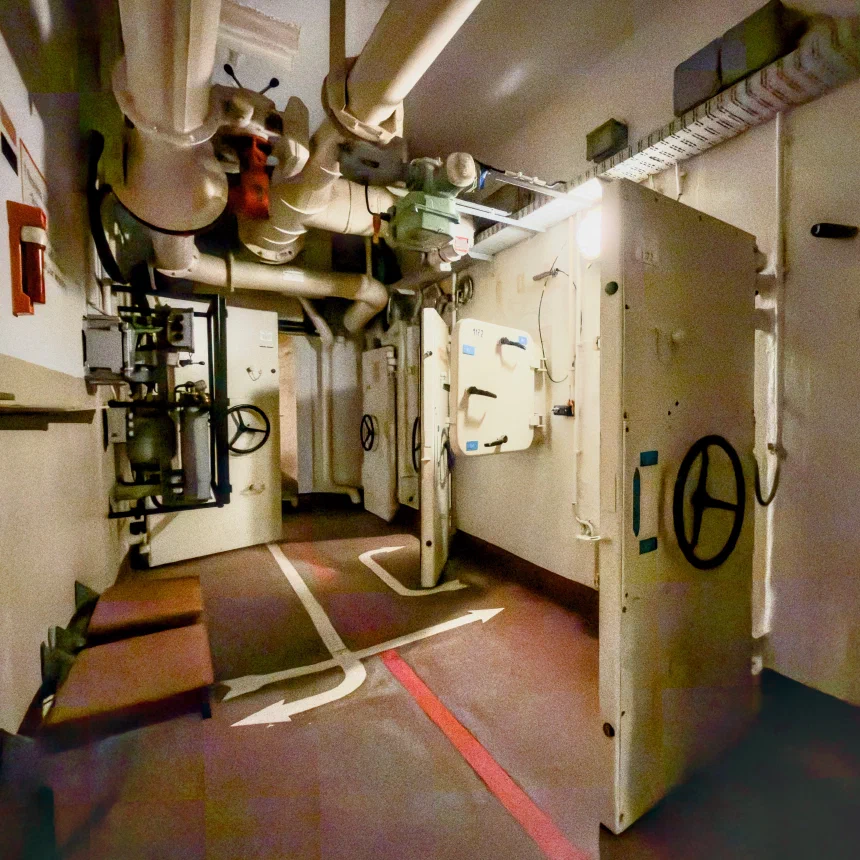
The colored arrows at the floor indicated the different stops the personal had to use depending on from where they came and what type of attack they were facing.
The Control Room
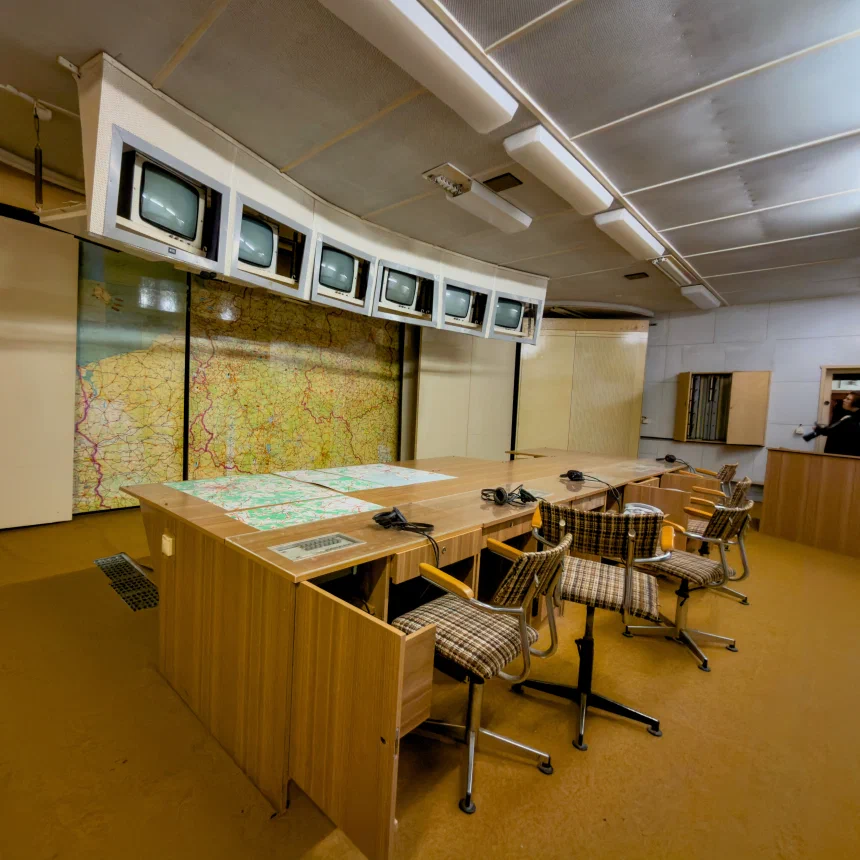
This is the jewel of the bunker, the control room. Completely intact with all the equipment needed to operate the bunker still present: Screens, headsets, maps and more.
The Living Room
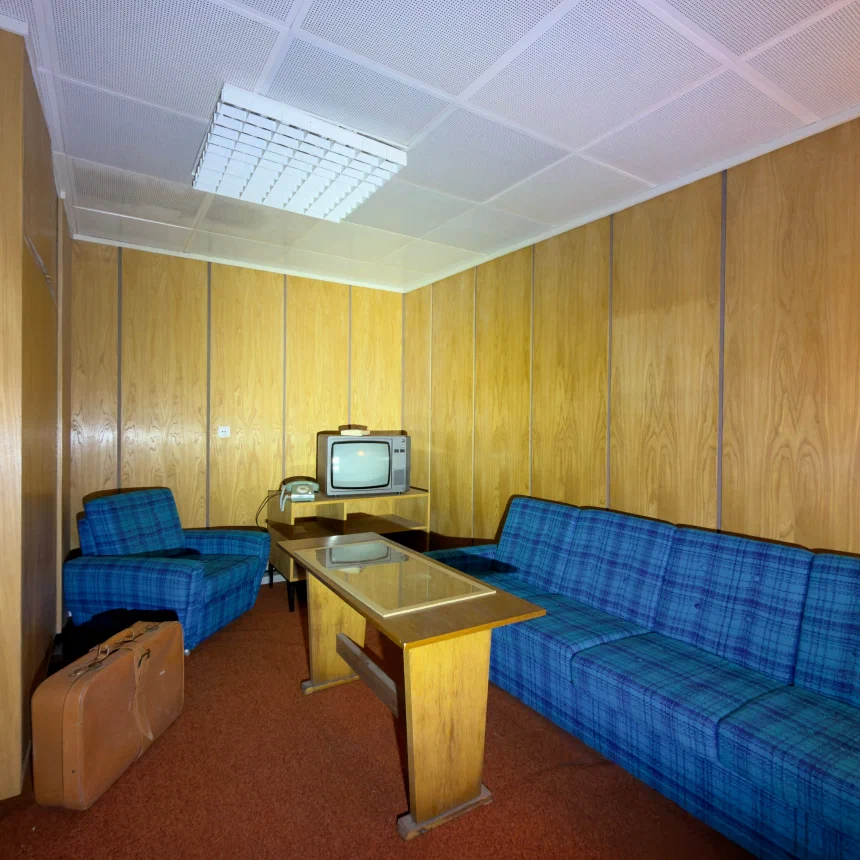
As you may can tell from the furniture this was the luxury living room of the bunker. It belonged to the commander on duty
Next ot the living room you’ll find the office of the commander on duty.
Office of the Commander
This is the office of the commander on duty. Throuh the open door you’ll find the living room I’ve mentioned in the previous chapter.
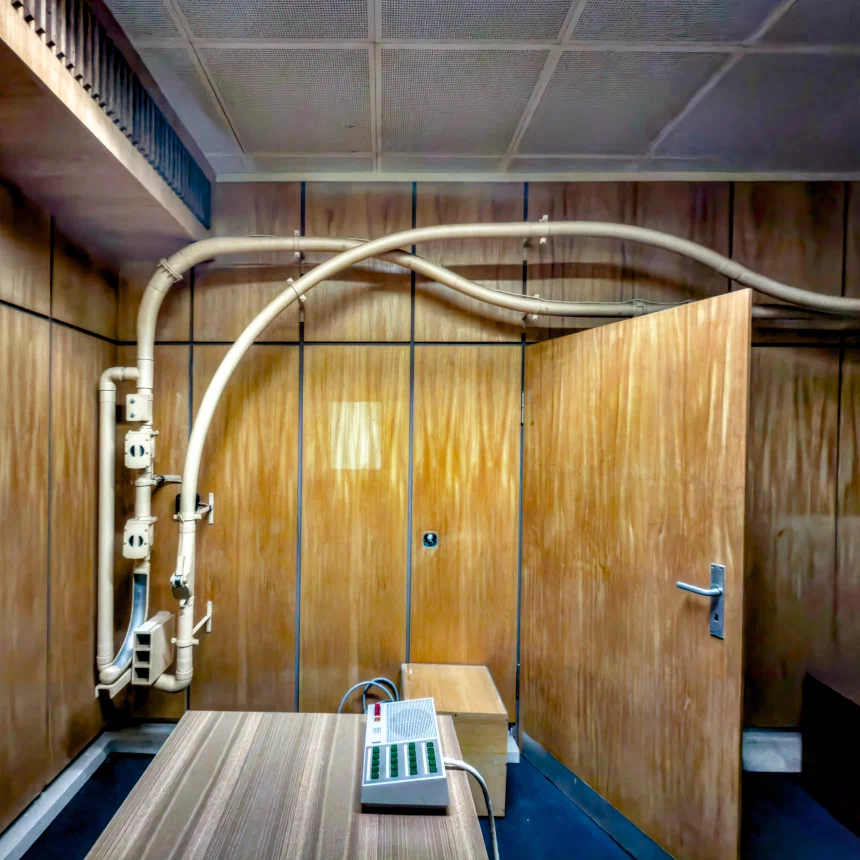
The pipes you’re seeing are part of the pneumatic tube system you’ll find on the first floor of the bunker.
Technical Control Room
The 3rd floor of the bunker belonged to the technical staff. Here you’ll find everything that was needed to operate the bunker.
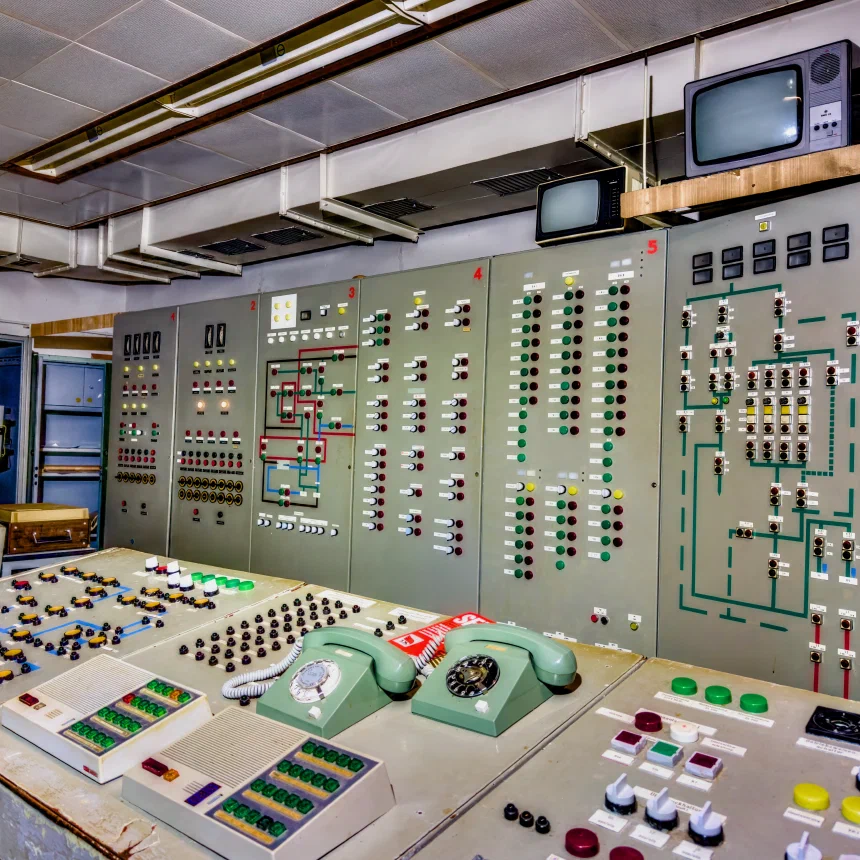
If you’re a tech enthusiast, you’ll find a variety of tools and equipment here like old computers, disk drives, tools, and other equipment.
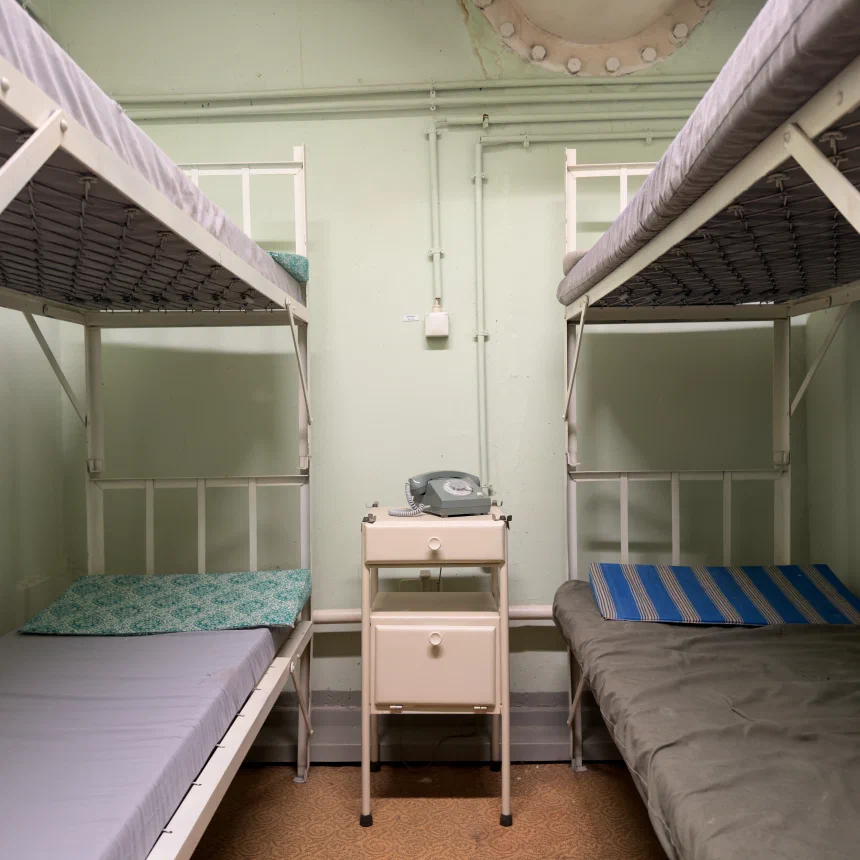
4-Person Sleeping Room
This sleeping room was next to the sick bay. So I donÄ’t know if it belonged to the sickbay and was actually a sleeping room for the wounded or for other personal.
Nice to Know About Bunker Harnekop
Equipment Used to Photograph Inside the Bunker
Photograping inside the former nucelar bunker is not hard. There’s electricity and light in almost every room; hence you don’t even need to use a tripod. There are a handful of rooms without light and for these rooms a bright flash light is useful. I took a few photos in such rooms using a 12.000 lumen flashlight. You can read more about it in my Wuben X1 flashlight review.
As always, I took the majority of the photos using ProCamera App in RAW mode. To learn more, head over to my blog post about how to shoot RAW on iPhone.
A Few Words About the History of Bunker Harnekop
The bunker has a fascinating history. Behind its camouflage as a military weather and communications outpost (codenamed “HNZ-8”), the East German Ministry of National Defense built one of the Cold War’s most sophisticated command bunkers. To conceal the massive construction area from Western spy satellites, specialized military engineers worked beneath enormous disguise sheds. Thousands of truckloads of excavated soil were driven away under the cover of night, while workers were strictly isolated from the outside world and kept on a strict “need-to-know” basis.
Above ground, two ordinary apartment blocks were built to disguise the entrance to the Harnekop bunker.
To protect against the violent shockwaves of a nuclear blast, the entire operational core and its living quarters were mounted on massive steel shock-absorbing springs. In an emergency, about 400 military leaders and technicians could have survived hermetically sealed from the outside world for weeks.
Here’s a timeline with the key dates of the bunker’s history:
Historical Timeline & Key Milestones
Is It Worth Visiting Harnekop Bunker?
Yes, it is definitely worth visiting Harnekop Bunker. It is a great example of a Cold War bunker and a great historical monument. As the bunker was so secret, everything inside was well preserved. It’s like visiting a secret military site in the 1970s!
To visit the Harnekop Bunker, you can to book a tour to the Harnekop Bunker with Go2Know.
If you’re more interested in a decayed, wet and dirty bunker, you might want to visit the abandoned Freudenberg Bunker. Both, the Harnekop Bunker and the Freudenberg Bunker, are just two of the many lost places in and near Berlin that you can visit legally by means of a public urbex tour.
Discussion
0 CommentsComments are moderated, links are deleted. So don't even bother spamming.
Just one more step
Please enter your name and email address. Your email will never be published.